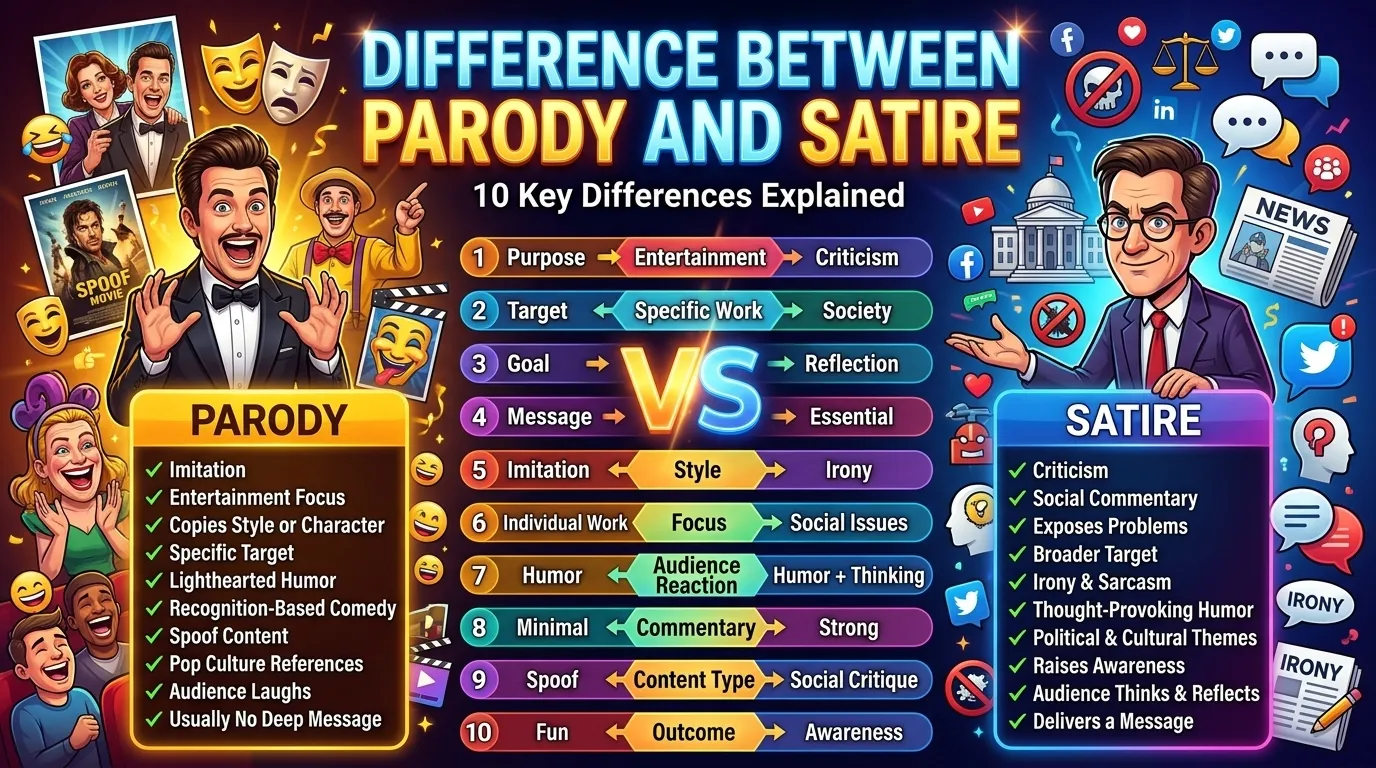
Many users get confused about the difference between parody and satire because both use humor, imitation, and criticism. At first glance, they can look very similar. However, the difference between parody and satire becomes clear when you understand their purpose, style, and message.
In simple words, parody mainly imitates a person, work, or style for comedic effect, while satire uses humor, irony, exaggeration, or ridicule to criticize social issues, politics, culture, or human behavior. Understanding the difference between parody and satire helps readers, writers, students, and content creators interpret media more accurately.
If you have ever wondered what parody is, how satire works, why people use them, or which one appears in movies, social media, and literature, this guide covers everything. You’ll learn definitions, examples, similarities, differences, practical uses, and expert insights in a simple and easy-to-understand format.
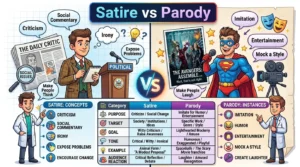
Quick Answer: Difference Between Parody and Satire
A parody imitates a specific person, style, movie, song, or work to create humor or entertainment.
A satire uses humor, irony, exaggeration, or sarcasm to expose problems, criticize behavior, or encourage social reflection.
Example: A comedy version of a superhero movie is a parody. A humorous film that exposes political corruption is satire.
Definition of Parody and Satire
- Parody: A humorous imitation of a person, work, genre, or style intended mainly to entertain or mock.
- Satire: A literary or artistic technique that uses humor, irony, exaggeration, or ridicule to criticize flaws in society, politics, institutions, or individuals.
Quick Example:
- A fake version of a famous song that copies its style is a parody.
- A comedy show criticizing government policies through humor is satire.
Pronunciation of Both Terms
| Term | US Pronunciation | UK Pronunciation |
| Parody | PAR-uh-dee | PAR-uh-dee |
| Satire | SAT-eye-er | SAT-ee-uh |
Now that you know what each term means, let’s understand the difference between parody and satire in greater depth.
Parody vs Satire Comparison Table
| Feature | Parody | Satire |
| Primary Purpose | Entertainment and imitation | Criticism and commentary |
| Target | Specific work, style, or person | Society, politics, culture, behavior |
| Tone | Playful and humorous | Humorous but often serious underneath |
| Message | May not have a deeper meaning | Usually carries a social message |
| Focus | Mimicking recognizable traits | Exposing flaws and problems |
| Audience Reaction | Laughter and recognition | Laughter plus reflection |
| Common Mediums | Movies, songs, memes, videos | Literature, journalism, TV, films |
| Need for Criticism | Not always | Almost always |
| Social Commentary | Optional | Core element |
| End Goal | Amusement | Awareness and change |
Key Differences Explained Between Difference Between Parody and Satire
1. Purpose
Parody exists mainly to entertain through imitation.
Satire exists to criticize and provoke thought.
Example: A funny imitation of a famous singer is parody. A comedy sketch exposing celebrity culture is satire.
2. Target
Parody targets a specific work or individual.
Satire targets larger issues such as politics, corruption, consumerism, or social behavior.
3. Message
Many parodies contain little or no deeper message.
Most satires carry an underlying criticism.
4. Emotional Impact
Parody usually seeks laughter.
Satire seeks laughter while encouraging reflection.
5. Social Relevance
Satire often becomes important during elections, political debates, and social controversies.
Parody can exist purely for entertainment.
6. Use of Irony
Satire heavily relies on irony.
Parody relies more on imitation and exaggeration.
7. Audience Interpretation
Parody is generally easier to understand.
Satire often requires knowledge of current events or cultural issues.
What Is a Parody and Why Does It Exist?
A parody recreates recognizable features of a person, genre, movie, book, song, or public figure in an exaggerated way.
The purpose is usually humor.
For example, many YouTube creators make parody trailers that imitate blockbuster films while adding absurd situations. The audience laughs because they recognize the original style.
Parody exists because imitation is one of the oldest forms of comedy. People naturally enjoy seeing familiar things presented in unexpected ways.
Common forms of parody include:
- Movie parodies
- Song parodies
- Social media memes
- Comedy sketches
- Television spoofs
What Is Satire and Why Is It Important?
Satire goes beyond entertainment.
It uses humor as a tool to expose flaws, hypocrisy, corruption, or irrational behavior.
Throughout history, satire has helped societies question authority and challenge harmful practices.
Writers, comedians, journalists, and filmmakers often use satire to discuss issues that might otherwise be difficult to address directly.
Examples include:
- Political satire
- Social satire
- Corporate satire
- Cultural satire
- Media satire
In practical use, satire encourages audiences to think critically about the world around them.
How Does the Difference Between Parody and Satire Affect Modern Media?
In today’s digital environment, the difference between parody and satire is more important than ever.
Platforms like YouTube, Instagram, and Meta host millions of humorous videos, memes, and commentary posts.
Some creators make parody content by copying trends for entertainment.
Others create satire that critiques influencer culture, misinformation, political movements, or consumer behavior.
Understanding the distinction helps viewers interpret the creator’s true intent.
Difference and Similarity Between Parody and Satire
| Feature | Parody | Satire | Similarity |
| Meaning | Imitation for humor | Criticism through humor | Both use comedy |
| Goal | Entertainment | Social commentary | Both engage audiences |
| Style | Mimics original work | Uses irony and exaggeration | Both can exaggerate |
| Target | Specific source | Broad issues | Both may target people |
| Criticism | Optional | Essential | Both may contain criticism |
| Creativity | High imitation | High commentary | Both require creativity |
| Audience Response | Recognition and laughter | Reflection and laughter | Both entertain |
| Popularity | Common in media | Common in journalism and comedy | Both appear widely online |
This table clearly shows the difference and similarity between difference between parody and satire for quick understanding.
Why Do People Often Confuse Parody and Satire?
Several reasons cause confusion:
Similar Use of Humor
Both forms use jokes and exaggeration.
Shared Media Formats
Movies, television shows, and social media often combine both.
Overlapping Techniques
A parody can contain satirical elements.
Cultural Influences
Modern entertainment frequently blends imitation and criticism.
Lack of Clear Labels
Many viewers consume content without knowing its literary category.
Common Mistakes with Difference Between Parody and Satire
Mistake 1: Thinking They Are Identical
Correction: Parody imitates; satire critiques.
Mistake 2: Assuming Every Parody Is Satire
Correction: Many parodies exist only for entertainment.
Mistake 3: Ignoring Social Commentary
Correction: Social criticism is central to satire.
Mistake 4: Confusing Mockery with Satire
Correction: Mockery alone is not necessarily satire.
Mistake 5: Believing Satire Must Be Funny
Correction: Satire can be subtle, dark, or serious.
Mistake 6: Looking Only at Surface Humor
Correction: Consider the creator’s deeper message.
Real-Life Examples with Difference Between Parody and Satire
Example 1: Personal Use
A student imitates a teacher’s speaking style for laughs.
Type: Parody
Example 2: Social Media Content
A creator mocks unrealistic influencer lifestyles to highlight social pressure.
Type: Satire
Example 3: Business Advertising
A company creates a humorous imitation of a competitor’s commercial style.
Type: Parody
Example 4: Political Commentary
A comedy show exposes government inefficiency using irony.
Type: Satire
Example 5: Entertainment Industry
A movie copies horror-film clichés for laughs.
Type: Parody
Example 6: Journalism
An article humorously highlights media bias and misinformation.
Type: Satire
When to Use Each
Use Parody When:
- You want entertainment.
- You want to imitate a recognizable style.
- You want humor without strong criticism.
- You are creating spoof content.
Use Satire When:
- You want to critique society.
- You want audiences to think.
- You want to expose flaws or hypocrisy.
- You want social commentary alongside humor.
Expert Insight
From a literary and media analysis perspective, the most important distinction is purpose.
In real scenarios, parody primarily relies on recognition. The audience laughs because they recognize the original source being copied.
Satire operates differently. The audience laughs, but the humor serves a larger purpose—revealing flaws, contradictions, or social problems.
Most beginners focus on how the content looks. Experts focus on why the content exists. That purpose usually reveals whether something is parody or satire.
Frequently Asked Questions
Is parody always funny?
Usually yes, but its primary goal is imitation rather than criticism.
Can parody be satirical?
Yes. A parody can include satirical commentary.
Which came first, parody or satire?
Both have ancient roots, but satirical writing dates back thousands of years.
Is satire always political?
No. Satire can target culture, business, technology, media, and everyday behavior.
Can a movie be both parody and satire?
Yes. Many modern films combine both techniques.
Why is satire important?
It encourages critical thinking and highlights social problems.
What is the easiest way to identify parody?
Ask whether the work is mainly imitating something recognizable.
What is the easiest way to identify satire?
Ask whether the humor is criticizing a larger issue.
Are internet memes parody or satire?
They can be either, depending on the creator’s purpose.
Is parody protected as creative expression?
In many countries, parody often receives legal protection as a form of creative expression, though laws vary by jurisdiction.
Conclusion
Understanding the difference between parody and satire becomes much easier when you focus on purpose rather than style. Both use humor, exaggeration, and creativity, but they aim to achieve different outcomes. A parody mainly imitates a recognizable person, work, song, movie, or style to entertain audiences. Satire, on the other hand, uses humor as a tool to criticize social issues, political systems, cultural habits, or human behavior.
In practical use, parody makes people laugh because they recognize what is being copied. Satire makes people laugh while also encouraging them to think more deeply about a problem or flaw. This distinction explains why some comedy feels purely entertaining while other comedy carries a powerful message.

I am content creator and comparison blogger focused on analyzing key differences between terms, concepts, and ideas to deliver accurate, easy-to-understand information. So I decided to create a platform where these differences are explained in the simplest way possible.