Many people searching for the difference between expunged and sealed records are trying to understand how a criminal record can affect jobs, housing, education, and future opportunities. While the terms are often used interchangeably, they are not the same.
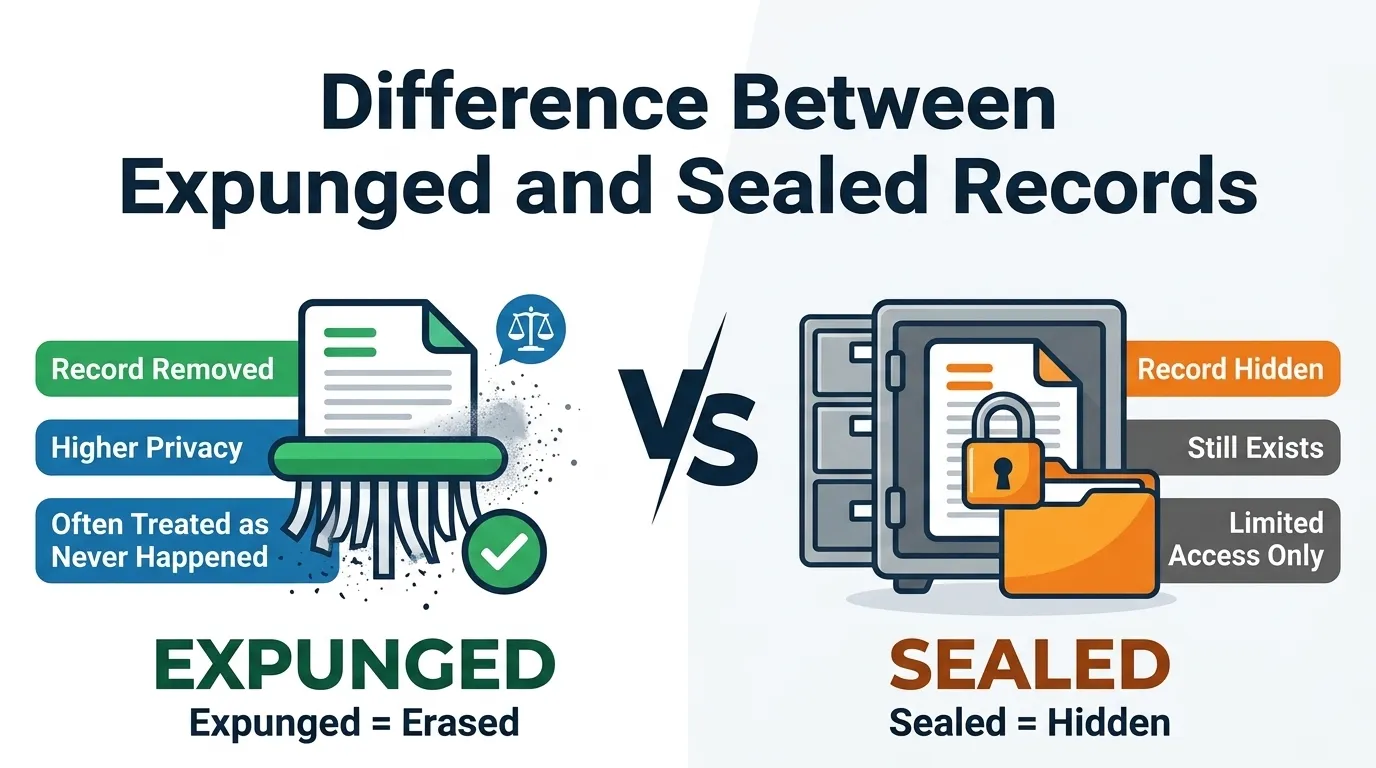
The difference between expunged and sealed records mainly comes down to visibility and legal treatment. An expunged record is generally removed or treated as though it never existed, while a sealed record still exists but is hidden from most public searches.
Understanding the difference between expunged and sealed records is important because laws vary by state, and the outcome can significantly impact your future. In this guide, you’ll learn what each term means, how they work, when to use them, common mistakes, real-life examples, and how search systems and background checks interpret them.
Quick Answer: Difference Between Expunged and Sealed
An expunged record is typically erased or legally treated as if it never happened.
A sealed record still exists but is hidden from public view and most background checks.
Example: If someone had a misdemeanor conviction, expungement may remove it entirely from public records, while sealing would simply restrict who can see it.
Definition of Difference Between Expunged and Sealed
- Expunged: A legal process that removes or destroys a criminal record, allowing it to be treated as though the event never occurred in many situations.
- Sealed: A legal process that hides a criminal record from public access while allowing certain government agencies and courts to continue viewing it.
Simple Example: Think of expungement as deleting a file, while sealing is like putting that file inside a locked cabinet.
Pronunciation of Both Terms
| Term | US Pronunciation | UK Pronunciation |
|---|---|---|
| Expunged | ik-SPUNJD | ik-SPUNJD |
| Sealed | SEE-ld | SEE-ld |
Now that you know what these terms mean and how to pronounce them, let’s understand the differences in greater detail.
Difference Between Expunged and Sealed Records: Comparison Table
| Feature | Expunged Record | Sealed Record |
|---|---|---|
| Meaning | Removed or erased legally | Hidden from public access |
| Public Visibility | Usually unavailable | Restricted but still exists |
| Background Checks | Often does not appear | May appear in some checks |
| Court Access | Limited access | Courts can still access |
| Government Agencies | May have restricted access | Usually retain access |
| Legal Status | Often treated as never occurring | Event still legally exists |
| Employment Impact | Generally less visible | May still be discoverable |
| Record Storage | May be destroyed or removed | Stored but restricted |
Deep Explanation
Expungement provides a stronger form of record relief because the record is often considered legally nonexistent. Sealing focuses on privacy by restricting public access while preserving the record for authorized entities.
Key Differences Explained Between Expunged and Sealed
1. Record Removal vs Record Restriction
Expungement generally removes a record from public databases.
Sealing only restricts access.
Example: A landlord may not see an expunged record, but certain agencies could still access a sealed one.
2. Legal Treatment
An expunged offense may legally be treated as though it never happened.
A sealed offense still exists in legal records.
3. Employment Screening
Many employers cannot view expunged records.
Some employers, especially government employers, may access sealed records depending on jurisdiction.
4. Court Accessibility
Courts may retain limited access to expunged information.
Sealed records are more commonly accessible to judges and court officials.
5. Future Criminal Proceedings
A sealed record may sometimes be considered during future legal proceedings.
Expunged records often receive stronger protections.
6. Eligibility Requirements
States usually impose different eligibility standards for expungement and sealing.
7. Privacy Protection
Expungement generally offers the highest level of privacy.
Sealing offers substantial but not complete privacy.
Why Do Expungement and Sealing Laws Exist?
The legal system recognizes that people can change.
A minor mistake made years ago should not necessarily create lifelong barriers. Expungement and sealing laws help individuals:
- Find employment
- Secure housing
- Access educational opportunities
- Reduce stigma
- Reintegrate into society
In practical use, these laws balance public safety with second chances.
How Does Record Expungement Work?
Expungement typically follows these steps:
- Determine eligibility
- File a petition
- Attend a court hearing if required
- Receive judicial approval
- Agencies remove or destroy records
Most beginners assume expungement happens automatically. In reality, applications, filing fees, and court approval are often required.
How Does Record Sealing Work?
Record sealing follows a similar legal process but focuses on restricting access.
Typically:
- Records remain stored
- Public databases are updated
- Most employers cannot view them
- Authorized agencies retain access
In real scenarios, sealing is often easier to obtain than expungement.
Difference Between Expunged and Sealed for Employment Opportunities
One of the biggest reasons people search this topic is employment.
Expunged Records
Many job applications allow applicants to answer “No” when asked about certain expunged offenses.
Sealed Records
Some employers may never see sealed records, but government agencies, law enforcement, and sensitive industries may still have access.
Industries with Stricter Screening
- Healthcare
- Law enforcement
- Government security
- Financial services
- Education
These industries often conduct deeper background investigations.
Can Expunged or Sealed Records Affect Housing Applications?
Yes.
Landlords frequently conduct background checks.
Expunged Record Impact
Expunged records usually provide stronger protection because the record is often unavailable during standard screening.
Sealed Record Impact
Sealed records may still appear in specialized searches depending on state laws and reporting practices.
This is why many legal professionals recommend expungement whenever available.
Difference Between Expunged and Sealed in Background Checks
Not all background checks are the same.
Standard Background Checks
Often do not reveal expunged records.
Professional Licensing Checks
May access additional databases.
Government Security Checks
Can sometimes access information unavailable to private employers.
Understanding the type of screening involved is crucial.
What Crimes Can Be Expunged or Sealed?
Eligibility varies by jurisdiction, but commonly eligible offenses include:
- Minor misdemeanors
- Juvenile offenses
- Non-violent crimes
- Dismissed charges
- Arrests without convictions
Serious violent offenses often face restrictions.
Always consult local laws before assuming eligibility.
Difference and Similarity Table Generation for Difference Between Expunged and Sealed
| Feature | Expunged | Sealed | Similarity |
|---|---|---|---|
| Purpose | Removes record effects | Restricts visibility | Both improve privacy |
| Public Access | Usually unavailable | Usually hidden | Both reduce public access |
| Court Access | Limited | Commonly retained | Courts may access information |
| Employment Benefits | Stronger | Moderate to strong | Both help job seekers |
| Housing Benefits | Stronger | Helpful | Both support applications |
| Legal Existence | Often treated as removed | Still exists | Both involve legal orders |
| Application Process | Court petition required | Court petition required | Similar procedures |
| Future Opportunities | Significant improvement | Significant improvement | Both support rehabilitation |
This table clearly shows the difference and similarity between difference between expunged and sealed for quick understanding.
Common Mistakes with Difference Between Expunged and Sealed
Mistake 1: Thinking They Mean the Same Thing
Correction: Expungement and sealing provide different levels of record protection.
Mistake 2: Assuming Eligibility Is Automatic
Correction: Most jurisdictions require formal applications.
Mistake 3: Ignoring State-Specific Laws
Correction: Rules vary significantly across states.
Mistake 4: Believing All Employers See the Same Information
Correction: Different employers use different screening methods.
Mistake 5: Assuming Serious Crimes Qualify
Correction: Many serious offenses are excluded.
Real Life Examples with Difference Between Expunged and Sealed
Example 1: College Student
A student arrested but never convicted obtains expungement, preventing the arrest from affecting future opportunities.
Example 2: Job Applicant
A candidate seals an old misdemeanor record and successfully passes standard employment screening.
Example 3: Healthcare Worker
A professional seeks expungement to avoid complications during licensing reviews.
Example 4: Small Business Owner
A sealed record reduces public visibility while allowing focus on business growth.
Example 5: Government Contractor
A security clearance investigation may still review information unavailable in ordinary background checks.
When to Use Each
Expungement Is Usually Better When:
- Available under state law
- Seeking maximum privacy
- Applying for competitive jobs
- Pursuing professional licensing
Sealing May Be Better When:
- Expungement is unavailable
- Faster relief is needed
- State law limits record destruction
The best option depends on eligibility and long-term goals.
Why People Get Confused About Expunged and Sealed Records
Many users get confused because:
- News articles use the terms interchangeably.
- State laws define them differently.
- Legal websites simplify explanations.
- Movies and television often misuse legal terminology.
- Search results sometimes mix both concepts together.
In simple words, both help protect your future, but they achieve that goal differently.
How Search Engines Understand Difference Between Expunged and Sealed and User Intent
Search engines such as Google analyze this query as a comparison-based legal information search.
When someone searches:
- “what is expunged”
- “what is sealed record”
- “expunged vs sealed”
- “difference between expunged and sealed”
Google recognizes informational and comparison intent.
The algorithm looks for:
- Clear definitions
- Side-by-side comparisons
- Legal explanations
- Real examples
- User-focused answers
This is why comprehensive comparison content tends to perform well for this topic.
Expert Insight
From a legal and practical perspective, expungement generally provides stronger protection than sealing. However, the “best” option is not always the same for everyone.
In real-world cases, many people are only eligible for sealing, not expungement. The smartest approach is understanding your state’s laws, future career plans, and long-term goals before filing.
Legal professionals often view both remedies as valuable tools for rehabilitation and opportunity restoration. The right choice depends on eligibility, timing, and personal circumstances.
Frequently Asked Questions (FAQ)
What is the main difference between expunged and sealed?
Expunged records are typically removed or treated as nonexistent, while sealed records remain hidden but still exist.
Is expungement better than sealing?
Generally, yes. Expungement often provides stronger privacy protection.
Can employers see sealed records?
Some employers cannot, but certain government and regulated industries may access them.
Can employers see expunged records?
In many situations, expunged records do not appear in standard background checks.
Do all states offer expungement?
No. Laws vary significantly by jurisdiction.
How long does expungement take?
The timeline depends on court procedures and local laws, often ranging from several weeks to several months.
Can felonies be expunged?
Some jurisdictions allow certain felony expungements, while others do not.
Does sealing remove a criminal record?
No. Sealing restricts access but does not erase the record.
Are juvenile records commonly sealed or expunged?
Many jurisdictions provide special protections for juvenile records.
Can a lawyer help with expungement or sealing?
Yes. Legal professionals can determine eligibility and guide the filing process.
Conclusion
Understanding the difference between expunged and sealed records is essential for anyone trying to move forward after an arrest, charge, or conviction. Although both legal remedies help reduce the impact of a criminal record, they operate differently.
An expunged record is generally removed or legally treated as though it never occurred, making it the stronger option when available. A sealed record, on the other hand, remains in existence but is hidden from public view and most routine background checks.
For beginners, the easiest way to remember the difference is this: expunged means erased, sealed means hidden. However, real-world outcomes depend heavily on local laws, eligibility requirements, and the type of background check being performed.

I am content creator and comparison blogger focused on analyzing key differences between terms, concepts, and ideas to deliver accurate, easy-to-understand information. So I decided to create a platform where these differences are explained in the simplest way possible.